Why reservations should live on your own domain, not on someone else's portal
A guest who books on a portal has learned the portal, not you. What happens when a portal shuts down, how intermediaries themselves price a guest from your website, and what to check before your booking form goes live.
A restaurant can take bookings in two places. The guest comes to your website and books there. Or the guest comes to a portal, browses twenty restaurants and one of them is you. Technically the outcome is the same, you have a booking. Commercially the difference is large and only shows after a few months, and in 2026 it showed very clearly.
Whose guest is it
A guest who booked on a portal has learned the portal, not you. Next time they open the portal, and the portal shows them your competitors alongside you, often the ones paying for a better position. A guest who booked on your website has learned your address and comes directly next time. That is the difference between a guest you have and a guest you rent.
The intermediaries admit as much in their own pricing. On TheFork Manager's pricing page (theforkmanager.com, September 2026), bookings that arrive via TheFork, TripAdvisor and partners are charged as a percentage of the average bill per guest, while bookings from your own website, Instagram and Facebook are included in the subscription without that fee. In other words, even the portal distinguishes between a guest it brought and a guest who is yours.
What happens when the portal shuts down
This is not theory. The homepage of quandoo.de (September 2026) carries a notice that Quandoo is ceasing operations in a planned, gradual process: the site remains available up to and including 30 September 2026, and the footer signs off as Quandoo GmbH i.L., in liquidation. Restaurants whose "Book" button pointed to Quandoo have, from October, a button that leads nowhere, and guests who learned that address have to learn them all over again. What to do in that situation is covered in Quandoo is closing: what you need to do.
When bookings live on your domain, the closure of any intermediary changes nothing for the guest. The address stays the same, the form stays the same, the booking history stays with you.
It does not have to be either-or
This is not a call to abandon portals. Portals bring guests who would otherwise never find you, especially tourists and people still deciding where to eat. A sensible split looks like this:
- A portal is a discovery channel: someone who does not know you. The same goes for a listing on the Jelo map, where guests search by town and cuisine and the booking goes directly to you, with no commission.
- Your website is the return channel: someone who already knows you and searches for you by name on Google.
The problem only arises when your website has no form, so even returning guests have to go through the portal. Then you are paying an intermediary for someone who was yours anyway.
What it looks like on your own domain
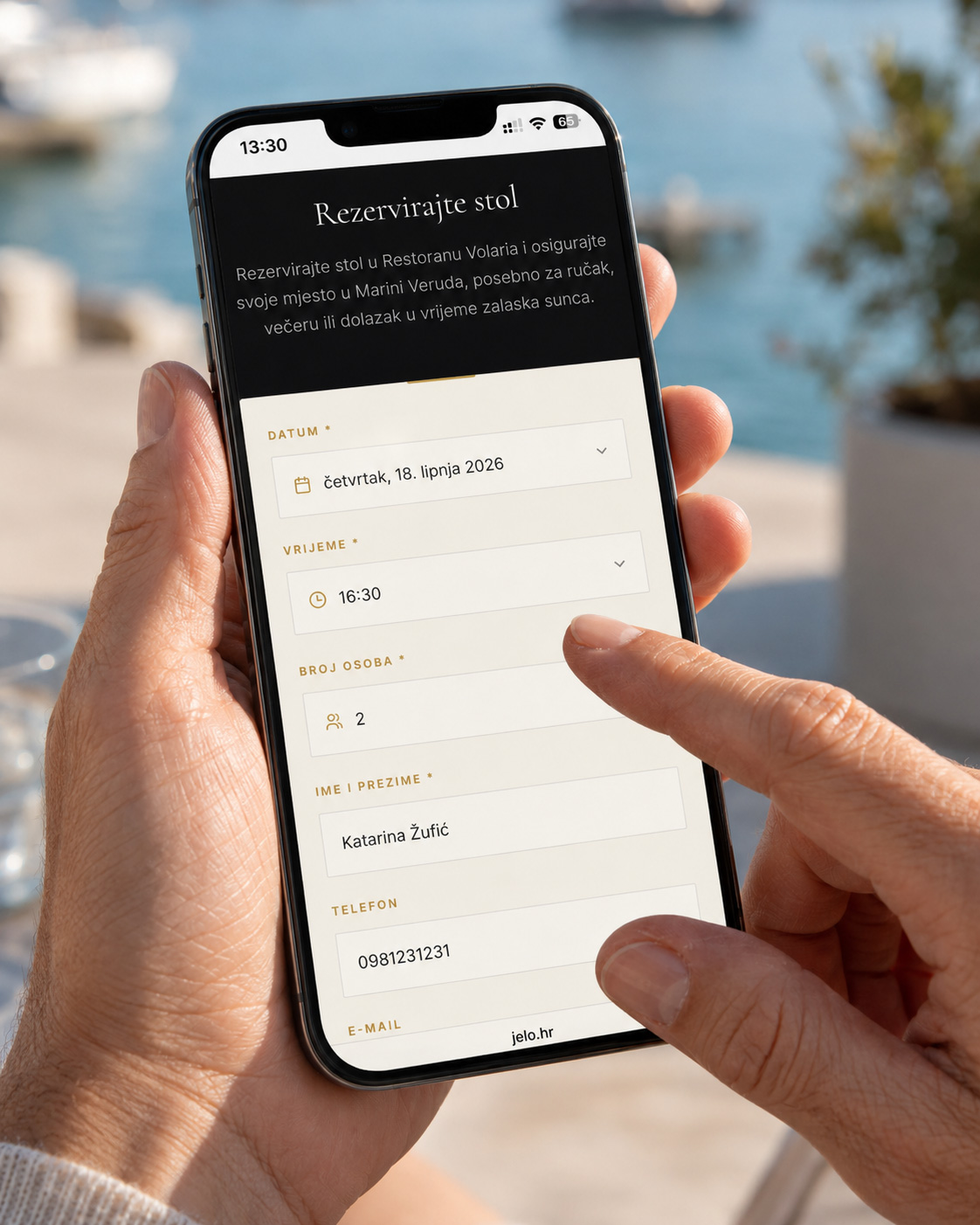
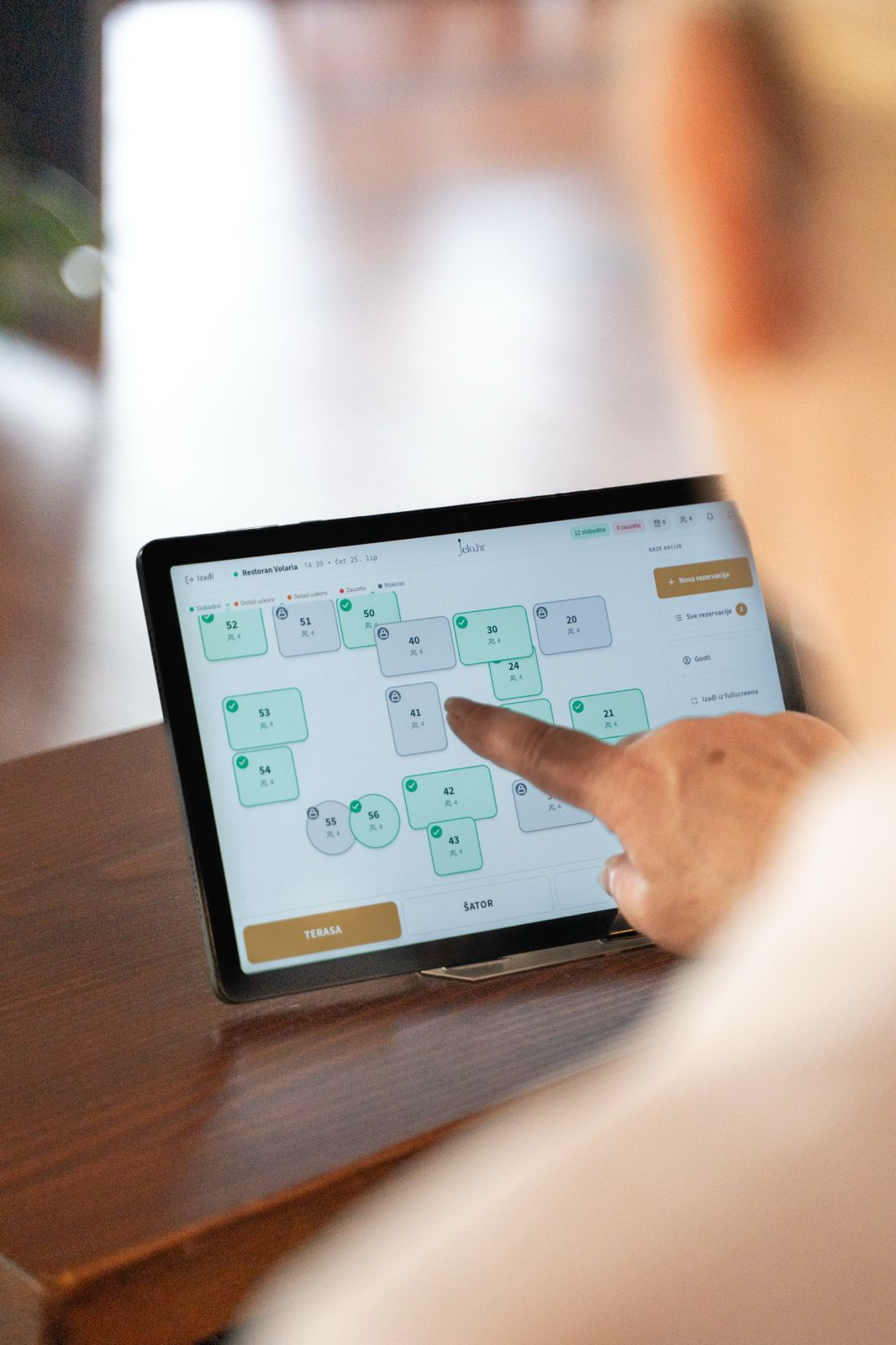
With jelo.hr, the restaurant website comes with an online reservation form built into the page, not a link to someone else's address. You connect your own domain to the site, so the guest stays on your address throughout. The form checks free tables against the table layout before confirming, offers up to three alternative times when the requested one is taken, and sends an email confirmation to the guest and a notification to the restaurant.
The site can be in Croatian, English, German and Italian, which for restaurants with tourists is the difference between a guest who books and a guest who gives up on a form they cannot read. One language is included in the one-time €99 activation, each additional language costs €25. The website and online reservations are already part of the Start plan at €39 per month, with no commission per guest or booking, and onboarding takes up to 24 hours.
What to check before you put the form live
- Does it work on a phone. Open the form on your own phone before you release it to guests, not on the office computer.
- How many steps to confirmation. Date, time, party size, name, contact. Every extra step loses some people.
- Where the notification lands. Make sure the booking actually reaches the person who sees it in time. An email nobody reads is not a notification; an alert on the tablet at the bar is.
- In which language. If half your summer guests speak German or Italian, a form in Croatian only leaves half your guests on the phone.
- Where the button on Google and Instagram leads. If the "Reserve" button on your Google profile points to a portal, a guest you brought becomes the portal's guest. Point it at your own address.
One test
Open your website on a phone and try to book a table as if you were a guest. Time it. If it takes more than a minute, if you end up at a phone number or on someone else's address, that is your guest's experience too. And that is the only argument you really need.
New venues get all Pro features free for 7 days, no card required. See the plans or send an enquiry and we will show you how your site with a booking form would look on your own domain.